How the JRNY Platform Powers Vehicle Subscription Programs

A vehicle subscription platform is the infrastructure that determines whether a subscription program runs or fails. Not the pricing strategy. Not the marketing. The platform. The global vehicle subscription market was valued at approximately $6 billion in 2024, with projections above $26 billion by 2030, according to Grand View Research. That growth is being driven by dealers and mobility operators who have stopped treating technology as an afterthought and started treating it as the operating foundation.
The JRNY Platform, built by Tomorrow's Journey, <link, if needed> is purpose-built automotive subscription platform software designed specifically for this job. This article explains what it does, how each layer of the platform works in practice, and what dealerships that have already launched on it have found.
Why Most Dealers Get the Sequence Wrong
There is a common mistake dealers make when they first explore subscription. They spend weeks working out the commercial side: which vehicles to include, how to price them, how to market the program. Then they circle back to the technology. By that point, they have already shaped a program around assumptions the software may not support.
The platform is not a tool that sits behind the program. It is the program. How it handles customer sign-up, recurring billing, contract storage, and fleet tracking determines whether the business runs on controlled, repeatable processes or on manual work that someone on the team is constantly holding together.
Traditional dealer management systems were designed for a different job. A vehicle sold, a service booking made, a finance deal closed. Each of those is a completed event. Subscription is built on ongoing relationships. The same customer, the same vehicle, monthly payments, mileage tracking, possible swaps, a return at the end. Without a vehicle subscription platform built for that model, dealers find themselves managing every one of those touchpoints manually, and the gaps widen as subscriber numbers grow.
There is also a more immediate reason this matters for US independent dealers specifically. Many are carrying aged used inventory, units sitting past sixty or ninety days, with floorplan costs accumulating and auction becoming the default exit. Subscription offers a way to put those units to work and generate monthly revenue from stock that would otherwise be discounted or wholesaled. But that only works if the infrastructure behind the program is capable of handling it properly. A platform that was built for rental, or one that has been adapted from a CRM, will not hold up under the operational demands of an ongoing subscriber relationship.
What the JRNY Platform Actually Does
The JRNY Platform manages the complete lifecycle of a subscription program, from the moment a customer browses available vehicles through to their return, inspection, and redeployment or remarketing. It is a single cloud-based system, not a set of integrated third-party tools, which means every action in one part of the platform is immediately reflected across the others.
There are four functional layers: the customer-facing sign-up journey, the contract and compliance infrastructure, the billing and payments engine, and the fleet management and back-office layer. Each is covered below.
The Digital Customer Journey
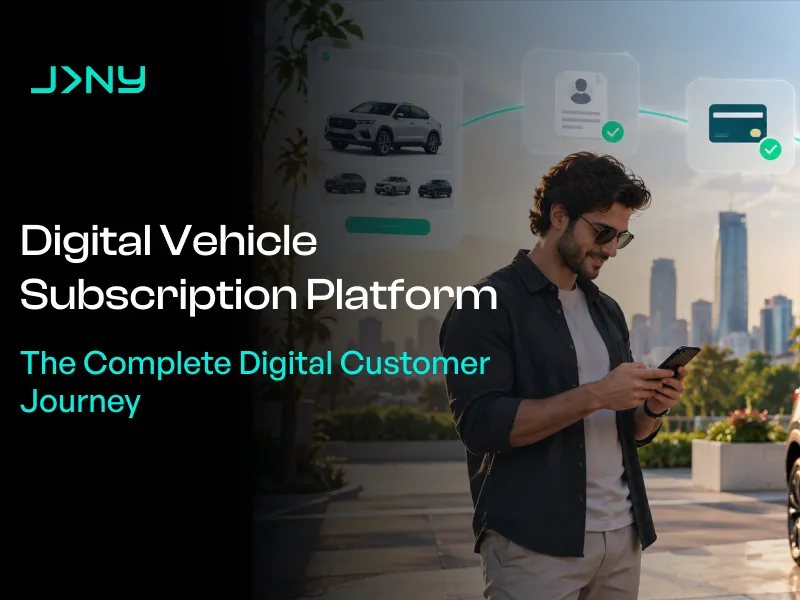
Before a subscriber ever speaks to anyone at the dealership, the platform is doing the work. In the JRNY Platform, the entire sign-up process is digital. A customer browses available vehicles on a branded interface, selects their subscription terms, completes identity verification, and signs a contract without paperwork, in-person visits, or manual handoffs between staff.
Deloitte's research into automotive consumer behaviour found that younger drivers, particularly the 18 to 34 age group, approach vehicle access with digital expectations shaped by every other service they use. An onboarding process that introduces unnecessary steps, paper, or wait times creates friction before a customer relationship has even started. The JRNY Platform's customer sign-up flow is built to remove that friction entirely. Customers browse and onboard on mobile in minutes.
The sign-up flow handles:
- Vehicle browsing and selection: a live inventory interface showing available vehicles, subscription terms, and pricing, updated in real time
- Identity and document verification: automated KYC checks validating driving licences and eligibility without manual review
- Digital contract execution: contracts generated, presented, and signed within the platform with no physical documents required
- Self-service account access: subscribers can view billing history, manage renewals, request swaps, or initiate returns through their own account dashboard
Every step that runs automatically is time the dealership team gets back. The administrative work that slows programs down, chasing documents, re-entering data, printing contracts, disappears from the workflow.
Identity Verification and Eligibility Screening
In a financed vehicle sale, the finance company carries most of the credit risk. In subscription, the dealer retains ownership of the vehicle throughout the subscriber relationship. That means the dealer also retains the risk, and the identity verification step is where that risk is either managed properly or deferred until it becomes a problem.
The JRNY Platform runs KYC and document verification natively within the onboarding flow. Government-issued ID is checked, driving licence data is cross-referenced, and eligibility is confirmed before any contract is generated. This is not a step that happens outside the platform and gets manually recorded. It runs inside the system, which means the eligibility check and its outcome are attached to the subscriber record permanently and are accessible to the dealership team at any point.
Dealers running verification through separate tools, or treating it as an informal check, create a consistent gap in their process. Checks get missed under pressure, records are not retrievable when needed, and the audit trail that matters in a dispute does not exist. Building verification directly into the onboarding workflow is what closes that gap from day one.
Recurring Billing and Payment Automation
Recurring revenue is only as reliable as the billing infrastructure behind it. Monthly subscription fees are not automatically predictable income. They become predictable when the platform collecting them handles the full billing cycle without manual input at each stage.
The JRNY Platform automates the complete billing cycle. Payments are charged on schedule, recorded, and reconciled automatically. When a payment fails, the platform triggers retry logic, notifies the subscriber, and escalates through a defined process without someone on the dealership team having to catch it. When a subscriber changes vehicle mid-period, the proration is calculated and applied to the next billing cycle without manual recalculation.
Stripe's analysis of the automotive subscription market identified reliable recurring payment management as one of the most common technical gaps in subscription programs, specifically noting that the difficulty of handling recurring payments and failed transactions had historically constrained automotive businesses from running subscription at scale. The JRNY Platform addresses this with native billing logic built for subscription rather than borrowed from a general payment processor.
Key billing functions the platform manages:
- Automated recurring charges: monthly fees collected on schedule with no manual trigger
- Failed payment handling: retry logic and customer notifications run automatically
- Proration and mid-cycle adjustments: changes are calculated and applied without manual reconciliation
- Variable charge application: excess mileage fees and damage charges attach directly to the subscriber's billing record
- Financial reporting: revenue collected, outstanding balances, and upcoming charges are visible in real time
For a dealership controller or CFO evaluating whether subscription makes financial sense, this is where the numbers become real. Knowing exactly what has been collected, what is outstanding, and what has failed is the difference between a program that generates confidence and one that creates monthly uncertainty.
Digital Contract Management
Every subscriber has a contract. How those contracts are generated, stored, and retrieved is not an administrative detail. It is the legal foundation the program runs on, and it becomes progressively harder to manage without proper infrastructure as subscriber numbers increase.
When a customer completes sign-up on the JRNY Platform, their contract is generated automatically. It is populated with their specific vehicle, pricing tier, mileage allowances, damage responsibilities, and return conditions, then sent, signed, and stored without leaving the platform. The signed contract links directly to the subscriber's record and stays there.
At ten active subscribers, manual contract management is inconvenient but workable. At thirty or fifty, version control breaks down, documents go missing, and disputes become difficult to resolve quickly. The JRNY Platform removes that constraint by making contract generation a native part of the onboarding workflow rather than a separate administrative task. Every subscriber receives a consistent, accurate contract, and every signed document is retrievable in seconds.
The contract layer also matters for dealers thinking about scale. A pilot starting with ten or fifteen aged units may grow to fifty or more vehicles once the economics are confirmed. Building that contract infrastructure into the platform from day one, rather than retrofitting it later, is one of the reasons the JRNY Platform is described as production-ready out of the box rather than requiring a long implementation cycle.
Fleet and Vehicle Lifecycle Management
From the dealer's perspective, a subscription program is a fleet management challenge. Vehicles need to be allocated to subscribers, tracked through the subscription period, returned, inspected, and either redeployed or moved out of the subscription fleet. The JRNY Platform manages this entire lifecycle within a single view, updated in real time as events happen.
This is where the difference between purpose-built subscription software and an adapted tool is most visible in day-to-day operations. Rental software tracks booking events: a vehicle out, a vehicle back, a charge collected. Subscription tracks relationships: a vehicle in ongoing use, payments recurring monthly, a subscriber whose status and terms may change over time. The JRNY Platform's fleet management layer is built around that ongoing relationship model, not retrofitted from a different data structure.
The platform tracks vehicle allocation and availability, maintenance scheduling linked to mileage and handover windows, digital damage records at handover and return, and return and redeployment decisions when a subscription period ends.
Vehicle utilisation is the metric that determines whether the economics of a subscription program actually work. A unit subscribed 80 percent of the time will consistently outperform a well-priced vehicle that sits empty between subscribers. For dealers who started a subscription program specifically to work aged inventory, idle vehicles defeat the purpose entirely. The JRNY Platform's real-time fleet view makes utilisation visible as it happens, not in a report assembled at the end of the month.
The JRNY Platform also includes an AI Agent with built-in damage recognition and smart pricing capabilities, which applies to the fleet management layer specifically. Damage assessments at vehicle return and pricing adjustments based on current market conditions can be handled with AI assistance rather than manual judgement calls, which reduces both administrative time and the risk of underpricing.
King Windward Nissan, an independent dealership in Hawaii, launched their subscription program, branded FlexRide, on the JRNY Platform and reached 60-plus active subscriptions within 60 days. The program went live in 45 days from start, and the dealership scaled without adding any additional headcount. Their owner noted that the platform gave them a cost-effective way to launch without disrupting daily operations. The full case study s available on the JRNY Platform website.
The Back-Office Layer: Operational Dashboards and Control
Everything above feeds into a centralised back office where dealership teams manage subscription operations day to day. Subscriber records, billing status, vehicle allocation, open contracts, upcoming renewals, and fleet utilisation all sit in one interface. The team is not toggling between systems or pulling figures from separate tools to understand where the program stands.
Role-based access means different team members see what is relevant to their function. The person managing handovers works with different information than the accounts team tracking billing, and both see different data than the used car manager reviewing fleet utilisation. The JRNY Platform supports all of those workflows inside one system. Decisions that would otherwise require manual coordination between team members are surfaced automatically.
For a dealer principal or GM evaluating whether to commit to a pilot, this is the operational guardrail that makes the answer easier. The program does not require new staff. It does not require the existing team to take on an undefined amount of manual administration. The workflows are defined, the data is centralised, and the platform runs most of the process automatically.
Why Purpose-Built Software Holds Up Where Adapted Tools Do Not
Running a subscription program on modified rental software, or on a CRM that was built for transactional sales, is one of the most common mistakes operators make at the start. These tools look adequate at a small scale. Ten vehicles, twenty subscribers, and the gaps are manageable. As the program grows, the workarounds that were tolerable at launch start multiplying faster than the subscriber base.
The architecture is the problem. Rental software is built around completed booking events. Subscription requires continuous relationship tracking, recurring billing logic, and dynamic fleet status that changes as subscriber relationships change. Bending a rental tool to serve that purpose creates friction at every junction.
The JRNY Platform is purpose-built for subscription. That distinction shows up in the billing logic, the contract workflows, the fleet tracking layer, and in the fact that a dealer can go from signed agreement to live program in weeks rather than months. No long implementation cycle, no custom development, no stitching together internal tools. The platform is production-ready from day one, as evidenced by the King Windward launch timeline.
For US independent dealers specifically, this matters because the typical entry point is a controlled pilot of 10 to 25 aged units. That is a small enough scope to manage carefully while generating real data on utilisation, subscriber behaviour, and net contribution. A platform that takes months to configure does not support that kind of fast, measured start. The JRNY Platform is built to go live quickly, scale without re-platforming, and run on the team and infrastructure already in place.
To Takeaway,
A vehicle subscription platform is not a tool that sits behind a subscription program. It is the infrastructure the program runs on, from the first digital sign-up through billing, contract management, fleet tracking, and the daily back-office operations that keep everything moving. Choosing a purpose-built vehicle subscription platform rather than adapting existing tools is the decision that determines whether a program scales cleanly or accumulates manual debt that constrains growth.
For dealerships with aged inventory and the appetite for a controlled pilot, the infrastructure question deserves to come before the commercial one. What the platform can do sets the boundaries of what the program can do.
To see what a subscription program could generate from your own lot, use the JRNY Dealer ROI Calculator <link: when Live> for a vehicle-level estimate based on your specific inputs.
Frequently Asked Questions
1. What is a vehicle subscription platform?
A vehicle subscription platform is software built specifically to manage the full lifecycle of a subscription program, covering digital customer onboarding, identity verification, contract generation and storage, recurring billing, and fleet tracking within a single connected system.
It differs from a standard dealer management system or rental tool in a fundamental way: those were built around completed transactions, while subscription depends on ongoing customer relationships that require continuous tracking, recurring billing logic, and dynamic fleet management. The JRNY Platform is one example of a purpose-built automotive subscription platform that handles all of these functions natively.
2.How does the JRNY Platform handle recurring payments?
The JRNY Platform automates the complete billing cycle: scheduling monthly charges, collecting payments, retrying failed transactions, applying mid-cycle adjustments when subscribers change vehicles or exit early, and producing real-time financial reports without manual input at each stage. For dealers, the practical result is that subscription revenue actually behaves like recurring revenue rather than requiring the accounts team to chase collection each month.
3. Can a dealership launch a subscription program without purpose-built platform software?
At a very small scale, yes, but the gaps become costly quickly. Billing exceptions require manual handling. Contract records drift as subscriber numbers increase. Fleet allocation becomes a coordination problem across team members working from different sources of information.
The JRNY Platform is purpose-built around subscription as a native operational model, which means dealers encounter fewer manual workarounds, cleaner data, and automation that holds up as the program grows rather than requiring constant patching.
4. What is identity verification in vehicle subscription, and why does it matter?
In a financed vehicle sale, the finance company absorbs most of the credit risk. In subscription, the dealer retains vehicle ownership and therefore retains risk throughout each subscriber relationship. Identity verification sits at the front of the onboarding process to manage that risk: automated checks on government-issued ID, driving licence validity, and eligibility run before any contract is generated. On the JRNY Platform, this runs natively within the onboarding workflow, so every subscriber clears the eligibility gate before reaching the contract stage, and the verification record stays attached to their file permanently.
5. What metrics does the JRNY Platform track for subscription programs?
Vehicle utilisation rates, subscriber retention, revenue per vehicle per month, fleet availability, and billing collection rates are the figures that matter most in subscription economics.
The JRNY Platform surfaces these in a real-time back-office dashboard rather than in end-of-month exports. Utilisation in particular drives subscription profitability more directly than pricing does. A platform that shows which vehicles are idle, and for how long, gives dealers the information they need to act before underperforming assets compound into a revenue problem.

More from the blog
Explore what others are learning