Key Capabilities of the JRNY Platform for Vehicle Subscription
When dealers and mobility operators evaluate vehicle subscription software, they usually start with the feature list. Does it handle billing? Can it generate contracts? Is there a dashboard? Those are the right questions, but they are not quite the right frame. The more useful question is what the platform allows the business to do reliably, at scale, without adding headcount or manual processes to hold everything together.
The JRNY Platform, built by Tomorrow's Journey, approaches this differently from most software in the market. It was not adapted from a rental tool or a leasing system. It was built specifically for subscription, from the billing logic up, and its architecture reflects that. According to BCG's analysis of the car subscription market, operators who underestimate the need for a well-integrated digital platform consistently find that individual features are not the problem. The problem is that features assembled from separate tools do not behave as a system. This article covers the five capabilities where that distinction matters most in practice.
The Difference Between a Feature and a Capability
Before getting into specifics, it is worth being precise about terminology, because the distinction shapes how to evaluate any vehicle subscription software.
A feature is a discrete function the software can perform. A capability is what the business can reliably do as a result of that function working in concert with others. A platform can have a billing module and still fail at payment automation if it lacks retry logic, proration, or real-time reconciliation. It can have a contract tool and still create compliance problems if that tool does not connect directly to the subscriber record and the fleet status.
Tomorrow's Journey built the JRNY Platform with a modular, white-label architecture that allows businesses to shape the platform around their existing operations, rather than adjusting their processes to fit the software. For dealerships, that distinction has real consequences. The five capabilities below are where that architecture shows its value.
Capability 1: Branded Digital Onboarding
The Sign-Up Experience Is the Product
The first thing a prospective subscriber does with a dealership's subscription program is try to sign up. How that goes sets the tone for the entire relationship. In a well-built vehicle subscription software environment, the whole sign-up process runs digitally from the customer's perspective: browsing inventory, selecting terms, verifying identity, and signing a contract on mobile or desktop, without waiting for a callback or filling out paper forms.
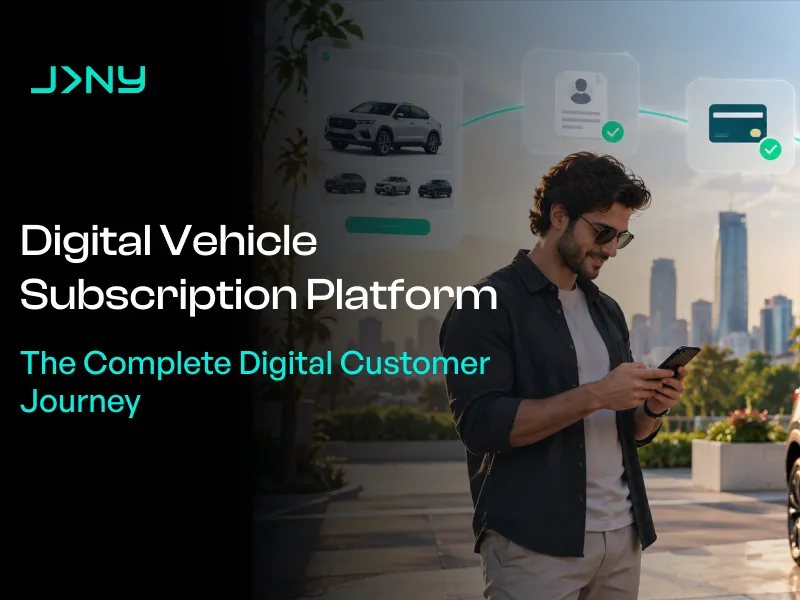
The JRNY Platform handles this through a fully branded customer journey. The interface is white-labelled to the dealership's own brand, so subscribers see a consistent experience tied to the dealership rather than a generic third-party portal. The platform guides customers through every stage of the booking process in a fully digital journey: select a vehicle, choose the right access model, verify identity, sign the contract, and manage everything that follows, all in a few minutes.
That last point matters more than it might seem. Data from Tomorrow's Journey's own client base shows that the typical subscription customer is 32 years old and lives in a metro area. That demographic does not tolerate friction well. Drop-off rates in onboarding flows that require manual steps or multiple handoffs are significantly higher than those in fully digital journeys, and in subscription the cost of a lost sign-up is not just one transaction but months of recurring revenue.
The JRNY Platform also includes the JRNY Agent, an AI-powered conversational tool that guides customers through the booking process using Natural Language Processing, matching them with vehicles and packages that suit their needs while drawing on real-time data including stock, specifications, pricing, and availability. For dealerships running subscription alongside a traditional sales floor, this reduces the burden on staff during onboarding without removing the personalised touch that differentiates a dealer relationship from a faceless subscription service.
From an operational standpoint, every subscriber who completes onboarding without manual intervention is time saved for the dealership team, with zero information lost. The subscriber record is created automatically, linked to their chosen vehicle, their contract, and their billing profile, before anyone on the team needs to touch it.
Capability 2: Contract Management That Scales
The Legal Foundation of Every Subscriber Relationship
Every subscription program runs on contracts. The question is whether those contracts are generated consistently, stored reliably, and retrievable quickly when they are needed. In programs that manage contracts outside the platform, even partially, the answer is usually unreliable.
The JRNY Platform generates contracts automatically as part of the onboarding workflow. The document is populated with the subscriber's specific vehicle, pricing tier, mileage allowance, damage liability, and return conditions, then presented for digital signature and stored directly within the subscriber's record. The dealership team does not need to create the document, chase a signature, or file the result. It happens within the platform flow.
Three specific problems this solves in practice:
- Version control. When contracts are managed outside the platform, different subscribers may be working from different template versions, especially in programs that have adjusted their terms after launch. The JRNY Platform uses a single, current template for every new subscriber, with signed versions archived and searchable by subscriber name, vehicle, or date.
- Dispute resolution. When a subscriber queries a charge or a return condition, the relevant contract is accessible in seconds. The full audit trail showing when it was sent, viewed, and signed is attached to the subscriber record permanently. Disputes that would otherwise involve trawling through email threads or shared drives are resolved by opening one record.
- Compliance consistency. For dealerships with ambitions to grow a pilot into a larger program, consistent contract infrastructure matters. The JRNY Platform's modular architecture allows features to be enabled as the program grows, from a ten-unit pilot to thousands of vehicles, without changing systems. The contract management layer works the same way at fifty subscribers as it did at ten.
The scalability point is worth sitting with. Dealers who run a successful pilot and want to expand face a specific risk: the processes that worked at small scale break down as volume increases. Contract management is one of the first places that happens. Building it into the platform from the start removes that constraint.
Capability 3: Payment Automation and Billing Intelligence
Recurring Revenue Requires Recurring Reliability
Subscription billing is not complicated in concept. A customer pays a monthly fee. In practice, managing that billing cycle reliably across a growing subscriber base requires logic that a standard payment processor does not provide out of the box.
The JRNY Platform handles the complete billing lifecycle natively. Monthly charges run automatically on schedule. When a payment fails, the platform's retry logic runs without manual intervention, escalating through defined notification steps before the account is flagged for review. When a subscriber changes vehicle mid-period or exits the program early, the proration is calculated and applied to the next cycle. Variable charges such as excess mileage fees and damage assessments attach directly to the subscriber's billing record with a linked source record.
For US-based dealers specifically, tax calculation across state lines is also handled automatically, removing a compliance layer that would otherwise require manual attention as the subscriber base grows.
Stripe's research into subscription billing challenges identified reliable handling of recurring payments and failed transactions as one of the most consistent operational gaps in automotive subscription programs. The JRNY Platform addresses this with billing logic built for subscription from the ground up, not a general payment gateway with subscription settings applied.
The downstream effect of getting this right is financial visibility that actually means something. A dealer's controller or CFO looking at the subscription program should be able to see, in real time, what has been collected this month, what is outstanding, what has failed, and what the forward projection looks like based on active subscribers. When billing runs inside the platform, those figures are always current. When billing is handled outside it, those figures require manual assembly.
Beyond the operational mechanics, this is the layer that makes subscription a credible financial channel for dealers who are sceptical. Floorplan pressure and aged inventory drain are problems dealers live with monthly. A billing system that generates predictable, trackable income from units that would otherwise be discounted changes the conversation from "is subscription viable?" to "how many units should we allocate?"
Capability 4: Fleet Lifecycle Management
Tracking the Asset Through Every Stage
The vehicle in a subscription program never leaves the operator's balance sheet. It is allocated to a subscriber, returned at some point, inspected, prepared, and either reallocated to the next subscriber or moved out of the subscription fleet. Every stage of that lifecycle needs to be tracked, and that tracking needs to be current rather than reconstructed from separate records.
The JRNY Platform manages vehicle lifecycle within the same system that handles subscriber management and billing. Fleet status is visible in real time: which vehicles are currently subscribed, which are in the preparation window between subscribers, which are available for new allocations, and which are in maintenance.
A specific capability worth examining here is the JRNY Handover and Inspection App. Designed to digitise the vehicle handover process, the app works offline and syncs to the platform when connectivity is restored, storing all inspection data locally until it can be uploaded. At the point of handover to a new subscriber, and at the point of return, the inspection record is created digitally, with photographic evidence attached, and linked directly to that subscriber's record. This creates a clear chain of custody that supports damage recovery without requiring paper forms, manual filing, or cross-referencing between systems.
Maintenance scheduling is also managed within the platform, with service alerts tied to vehicle mileage and handover windows. Vehicles are flagged for maintenance when they return from a subscription period, rather than mid-subscription when taking them out of rotation is disruptive and costly.
The JRNY Intelligence layer, part of the broader JRNY Platform stack, applies data tools to fleet and inventory decisions. For dealers using subscription to work through aged inventory, the ability to see which units are generating the highest utilisation, what pricing tiers are performing best, and when vehicles should rotate out of the subscription fleet and into retail or wholesale is the difference between subscription as an experiment and subscription as a managed revenue channel.
Al-Futtaim's MOOV subscription service in the UAE, one of JRNY's longest-running enterprise clients, grew to over 5,000 active subscribers on the platform. At that scale, fleet lifecycle tracking is not a nice-to-have feature. It is the operational infrastructure the business runs on.
Capability 5: The Operational Dashboard
One View of the Entire Program
The operational dashboard is where the dealership team actually runs the subscription program day to day. All of the data generated by onboarding, contracts, billing, and fleet management flows into a single back-office interface that shows the current state of the program without requiring anyone to check separate systems or compile figures manually.
Subscriber records, billing status, vehicle allocation, open contracts, upcoming renewals, and fleet utilisation are all accessible in one place. Role-based access means the handover team sees what they need, the billing team sees what they need, and the dealer principal or GM gets the program-level view: how many active subscribers, what revenue has been collected, what the fleet utilisation rate looks like, and what is coming up in the next 30 days.
For a used car manager evaluating whether the subscription pilot is working, the dashboard shows which units are generating revenue, which are idle, and what the average days-in-subscription looks like across the fleet. For the controller, it shows monthly recurring revenue, outstanding balances, and payment success rates without a manual data pull at month end. For the operations lead, it shows scheduled handovers, pending inspections, and vehicles due for return.
The JRNY Platform also offers three deployment tiers that reflect different points in a dealer's subscription journey. JRNY Flex Standard is built for swift deployment and quick returns, focusing on customer experience and efficient operations. Flex Advance comes with all features pre-configured for a faster route to market. The Enterprise tier offers bespoke solutions tailored to specific operational requirements. For independent US dealers starting with a 10 to 25 unit pilot, the Flex Standard path provides a production-ready starting point without an extended implementation cycle. For dealer groups looking to run subscription across multiple locations, the Enterprise tier handles the complexity that comes with scale.
The dashboard view changes as a program grows, surfacing different metrics and operational priorities as subscriber numbers increase. At ten subscribers, the value is simplicity and control. At a hundred, it is the consolidated visibility that stops a growing program from outrunning the team managing it.
How the Five Capabilities Connect
Each of the five capabilities above matters on its own terms. But the reason they are being discussed as capabilities of a single platform rather than as individual features is that the value comes from how they connect.
A subscriber who completes onboarding through the JRNY Platform has a contract stored and linked to their record. That contract governs the billing cycle. The vehicle they selected has its status updated in the fleet view. The payment collected is reflected in the financial dashboard. If they change vehicle mid-subscription, the contract amendment, the billing adjustment, and the fleet reallocation all happen within the same system.
When these functions are handled by separate tools, even good ones, the junctions between them are where errors occur, data gets out of sync, and manual reconciliation becomes a weekly task. That friction is not obvious at the start of a program. It accumulates as subscriber numbers grow, and by the time it becomes a serious problem, the program has already developed habits around working around it.
The JRNY Platform's architecture removes those junctions. It is one of the first platforms purpose-built for subscription and usage-based mobility, rather than adapted from rental or leasing infrastructure. That heritage shows up in the details of how each capability works and in how they work together.
For dealerships interested in what this looks like in practice, the JRNY Platform’s Dealers page covers the operational workflow from sign-up to return. The JRNY Dealer ROI Calculator gives a vehicle-level revenue estimate based on a dealer's own inventory inputs.
To sum up,
The capabilities that define effective vehicle subscription software are not complicated in isolation. Smart onboarding, reliable contract management, automated billing, fleet lifecycle tracking, and a consolidated operational dashboard are all well-understood requirements. The challenge is finding them delivered as a connected system rather than assembled from separate tools that require constant manual coordination.
The JRNY Platform was built to deliver these five capabilities within a single, purpose-built automotive subscription platform. For dealers evaluating their options, the capability question is ultimately the most practical one to start with. What the vehicle subscription software can do reliably at scale will determine what the program can become.
Frequently Asked Questions
1 . What is vehicle subscription software?
Vehicle subscription software is a platform built to manage the operational lifecycle of a subscription program, covering customer onboarding, identity verification, contract management, recurring billing, fleet tracking, and back-office reporting within a connected system. The JRNY Platform is purpose-built for this use case, which distinguishes it from rental or leasing software adapted for subscription.
The difference shows up in the billing logic, the contract workflows, and the fleet management layer, all of which are designed around ongoing subscriber relationships rather than one-time transaction events.
2. What should I look for when choosing vehicle subscription software?
The most important question is whether the platform was built for subscription or modified from something else. Beyond that, check whether key functions like billing, contract management, and fleet tracking are native to the system or connected through third-party integrations.
Third-party integrations create data sync problems and manual reconciliation steps that grow more costly as subscriber numbers increase. Also ask about deployment timelines: a platform that takes months to configure is not suitable for a dealer who wants to run a controlled pilot with aged inventory and measure the results within a defined window.
3. How does the JRNY Platform handle payment automation?
The JRNY Platform automates the full billing cycle: scheduling monthly charges, processing payments, running retry logic when a payment fails, applying proration when a subscriber changes vehicles or exits mid-period, and generating real-time financial reports. Variable charges like excess mileage or damage fees attach directly to the subscriber's billing record with a linked source document.
For US dealers, state-level tax calculation is handled automatically. The result is that the billing team is not manually managing exceptions or assembling financial reports from separate systems at month end.
4. What is the JRNY Handover and Inspection App and how does it work?
The JRNY Handover and Inspection App is a purpose-built tool that digitises the vehicle handover process at the start and end of each subscription period. Staff use it to record the vehicle's condition with photographic evidence, which is stored offline if needed and synced to the platform when connectivity is available.
The inspection record links directly to the relevant subscriber's record, creating a clear chain of custody that supports damage recovery without manual filing or cross-referencing between systems. It replaces the paper-based damage forms that most dealerships use at handover.

More from the blog
Explore what others are learning