EV Inventory Pressure: Why Subscription Is the Smartest Way to Move Surplus Stock
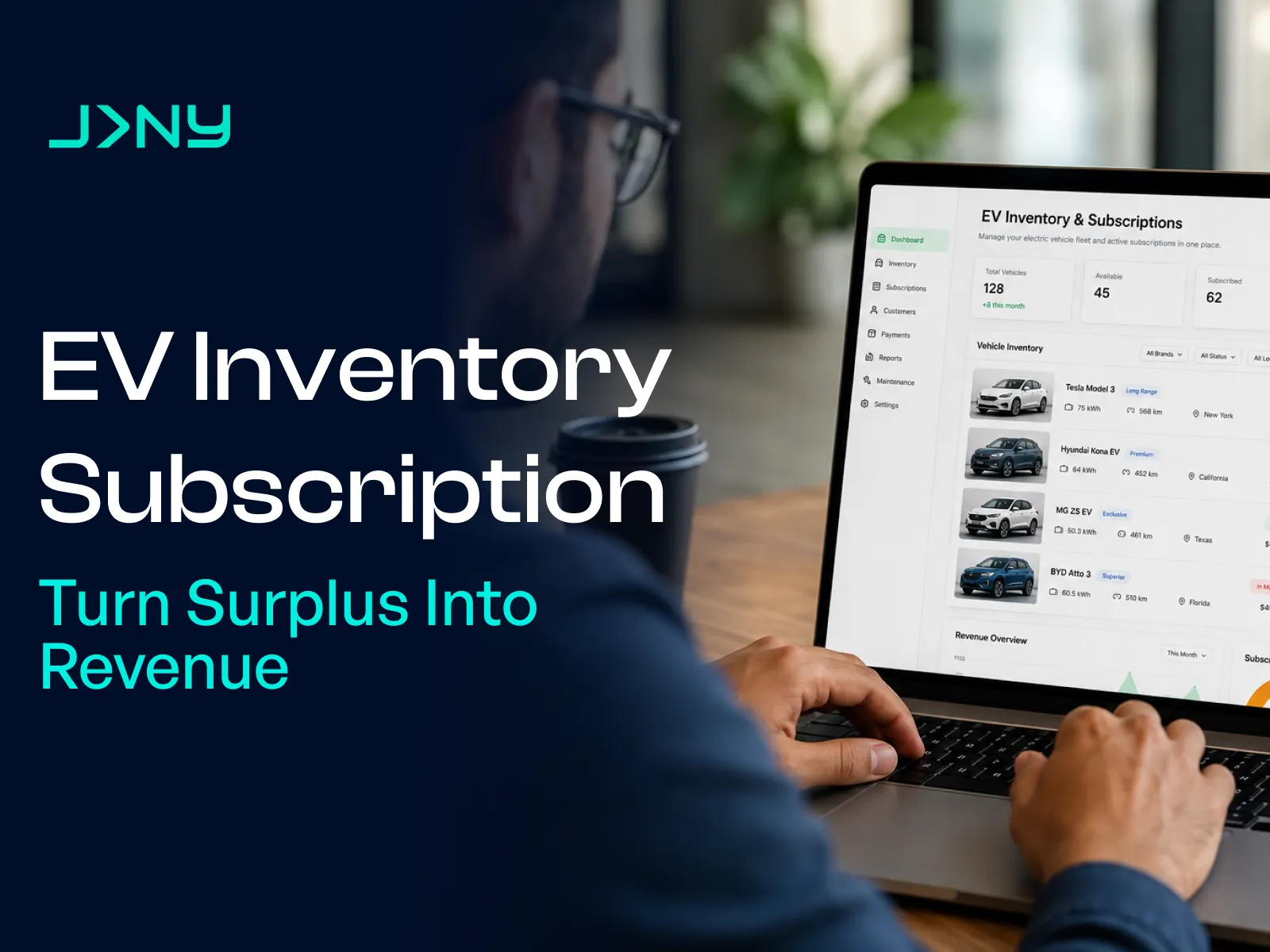
EV inventory subscription dealership programs are moving from a niche experiment to a practical operational response to one of the most persistent problems on the lot right now. Electric vehicles are sitting significantly longer than comparable gas vehicles, they are depreciating faster while they wait, and the conventional exit strategies, deeper discounts, auction, or waiting out the market, each carry their own cost. Subscription offers a fourth option that most dealers have not fully considered: generating monthly income from slow-moving EV stock while simultaneously placing consumers in those vehicles under the lowest-commitment terms available. This article covers the market conditions driving that shift, how subscription solves three distinct EV inventory problems at once, and which types of EV stock work best in a subscription program.
The EV Inventory Problem Is Real and Measurable
The numbers that characterize the current EV inventory situation are not subtle. At the end of November 2023, US dealers carried a 114-day supply of new EVs, compared to a 71-day supply for the industry overall, according to Cox Automotive. Historically, a 60-day supply is considered the healthy benchmark across all vehicle types. EVs were sitting at nearly double that rate while the rest of the lot operated closer to normal.
That gap has not closed neatly since. An iSeeCars analysis published in December 2025 found that EVs were averaging 1.3 percent of 2024 model-year stock still remaining on dealer lots, more than triple the industrywide average of 0.4 percent. Specific models were dramatically worse. The BMW i4 had 89.2 percent of its 2025 inventory still unsold, with the Genesis GV60, Chevrolet Silverado EV, and several other models not far behind. These are not fringe vehicles. They are mainstream entries from established brands sitting well past the point where discounting alone moves them.
The depreciation picture compounds the problem. Electric vehicles lose value faster than comparable gasoline vehicles, with EVs averaging 50 to 60 percent depreciation by year three versus 40 to 50 percent for gas cars, according to a 2026 analysis from Carvira. From early 2023 to late 2024, the average price of a used three-year-old EV dropped 25 percent, according to ACV Auctions. That trajectory directly affects the residual calculation on unsold new units. A new EV sitting on the lot for 90 days is not just accruing holding costs. It is also moving toward a sale price that reflects what three months of market deterioration has done to comparable used vehicles.
The lease return wave arriving in 2026 adds another layer of complexity. More than 300,000 EVs are expected to return from lease in 2026, a figure that represents an increase of over 200 percent from the roughly 123,000 units that returned in 2025, according to CDK Global's January 2026 analysis. The surge traces directly to the heavy leasing activity of 2022 and 2023, when federal and state incentives substantially lowered monthly payments and pushed a large cohort of buyers into three-year EV leases. Those leases assumed residual values near 50 percent. Actual residuals in the current market are closer to 35 to 40 percent, which means many returning lessees are walking away rather than buying out their vehicles, sending those units into wholesale channels and adding further pressure to an already well-supplied used EV market.
For dealers sitting on prior model-year EVs, off-cycle stock, or preparing to absorb returned leases, this is the context that makes the subscription channel worth examining seriously.
Why Conventional Exit Strategies Are More Expensive Than They Look
The reflex response to surplus EV inventory is some combination of the three standard exit moves: cut the price, wholesale it, or wait and hope the market shifts. Each of these carries costs that are less visible than they appear in the moment.
- Discounting is the most common response, and the one most likely to create downstream damage beyond the individual unit. When a dealer repeatedly marks down EV prices to move inventory, that pricing history becomes public data. Platforms like CarGurus and AutoTrader surface price-drop history to every subsequent shopper who looks at the vehicle. A car with four markdowns over 90 days signals to buyers that the floor is lower than the current asking price, which erodes the negotiating position even after the discount has been applied. More broadly, aggressive EV discounting by individual dealers contributes to the market-wide residual value erosion that is making future EV inventory harder to price correctly at acquisition.
- Wholesaling or sending to auction avoids the lot cost but absorbs a loss that has grown more predictable and more painful over the same period that new EV supply has been building. The gap between original residual assumptions and actual wholesale returns on returned EV leases, roughly 10 to 15 percentage points in the current market, means dealers sending EVs to auction are recovering less per unit than their acquisition models anticipated. iSeeCars noted that federal incentive removal has further complicated this picture, with industry analysts observing that even the former $7,500 federal tax credit was not sufficient to clear these vehicles at the original pricing, making pricing flexibility unavoidable for dealers still trying to move them.
- Waiting is the least visible cost but often the largest one. Standard holding cost benchmarks for used vehicles run between $50 and $85 per day when depreciation is included, as documented by WardsAuto and Colonnade Advisors. On a $45,000 EV sitting at the higher end of that range, a 90-day holding period accumulates $4,500 to $7,650 in combined carrying cost and depreciation. The vehicle is simultaneously costing money and becoming harder to sell at the price needed to recover that cost. Waiting, for EV inventory specifically, is not a neutral option.
Three Problems Subscription Solves Simultaneously
A subscription program addresses the EV surplus situation differently from any of the three conventional exits because it changes the vehicle's status from a cost-accruing asset to an income-generating one without requiring it to leave the dealership's ownership. Three distinct problems get addressed in the same channel.
Problem One: The Vehicle Is Sitting and Costing Money
The most immediate problem is that every day an EV sits unsold is a day it accrues holding cost while its residual value moves in the wrong direction. Subscription converts that daily holding cost into a net contribution by generating monthly revenue from the vehicle while it waits for the right retail buyer at the right price.
A prior model-year EV priced at $42,000 subscribed at $800 per month generates $2,400 over a 90-day period. That $2,400 does not make the eventual sale price irrelevant, but it meaningfully changes the unit's economic position during the period it would otherwise be sitting idle. The dealer still retains ownership, the vehicle remains available for retail sale, and the subscription income offsets a significant share of the holding cost that would otherwise accumulate entirely as loss.
This is the same yield logic that applies to aged used inventory of any type, with one additional dimension specific to EVs: the depreciation curve on unsold electric vehicles is steeper than on gas vehicles, which makes the cost of doing nothing higher, not lower, than it would be on a comparable ICE unit.
Problem Two: Buyer Hesitation Rooted in Commitment
The second problem is on the demand side. The consumer hesitation driving slow EV sales is not primarily about price, although price matters. It is about commitment to a vehicle type that many buyers have never owned and have real concerns about.
AAA's June 2025 survey found that only 16 percent of US adults said they were likely or very likely to purchase an EV as their next vehicle, the lowest figure recorded since 2019. Among the reasons people cited for not considering an EV purchase: 62 percent expressed concern about high battery repair costs, 59 percent were deterred by higher upfront prices, and 57 percent felt EVs could not handle their driving needs. According to YouGov's January 2026 data, range anxiety remains the leading barrier at 49 percent, followed closely by battery safety and longevity concerns at 47 percent.
These are not objections that respond well to a price cut. A buyer who is uncertain about whether an EV fits their daily routine is not significantly more likely to make a 60-month purchase commitment because the sticker price dropped $3,000. The risk feels the same at a lower number. What resolves these objections is experience, and the only way a buyer gets experience with an EV is by driving one in their actual life for an extended period.
Subscription provides exactly that pathway. A customer who subscribes to an EV for one to three months at a monthly fee faces none of the commitment risk that makes a purchase feel high-stakes. If range is genuinely insufficient for their routine, they find out and return the vehicle without having financed it. If the range is adequate and the driving experience converts them, they have become a buyer who no longer needs to be convinced. AAA published guidance in August 2025 specifically titled "Curious About EVs? Try Renting Before Buying," validating this exact framing from one of the most consumer-trusted sources in automotive.
The JD Power 2025 US Electric Vehicle Experience Ownership Study adds the crucial data point on the other end of this pathway. Among current EV owners, 94 percent indicated they were likely to purchase another EV for their next vehicle. That figure has been consistent across five years of the study, ranging between 94 and 97 percent. The experience converts. The problem is not that people dislike EVs once they own one. The problem is getting them into one in the first place under terms that feel manageable.
Problem Three: The Vehicle Leaves the Dealer's Ecosystem
When an EV is wholesaled or sold at auction, it leaves the dealership's ecosystem entirely. The relationship with the next buyer, the service revenue, the trade-in opportunity, the repurchase, all of it goes with the vehicle to whoever buys it in the wholesale channel.
Subscription keeps the vehicle in the dealer's ecosystem for the duration of the subscription period. The subscriber becomes a known customer with a documented interaction history. When the subscription period ends, the dealer has a natural conversation about what comes next: a retail purchase, a different vehicle in the subscription fleet, or a transition to another program. That conversation does not exist when the vehicle has been wholesaled.
The service lane dimension applies here too. Every subscribed EV requires maintenance during its subscription period, on the dealer's own schedule. Battery health checks, software updates, tyre rotation, routine inspections: these are service lane opportunities that the dealer controls rather than losing to independent shops. S&P Global's EV Lease Returns Impact analysis noted that brand loyalty runs at 64 percent for lease households versus 47 percent for purchase households, precisely because the ongoing relationship creates more touchpoints. A subscription program creates the same dynamic.
The Subscriber-to-Buyer Pathway for EVs
The conversion from subscriber to buyer is the part of the EV subscription argument that dealers are most sceptical about, and it deserves a direct examination.
The pathway works as follows. A prospective buyer who is curious about EVs but unwilling to commit to a purchase subscribes for one to three months. During that period, they experience the vehicle's actual range in the context of their actual commute, they learn the home charging routine, they encounter the public charging network on the occasions they need it, and they form a real view of whether the vehicle suits their life. The factors that drove hesitation in the abstract, range, charging infrastructure, battery longevity, either confirm themselves as genuine barriers or dissolve when measured against real usage.
For the subset of subscribers who find that the EV works for them, the conversion to buyer is a natural next step. The dealership has already established a relationship, already holds the vehicle, and already has a customer who has demonstrated both the ability to pay and a preference for the specific vehicle they have been driving. That is a considerably warmer sales position than a cold walk-in from a customer who has never been in the vehicle.
For the subscribers who determine the EV is not the right fit for their routine, the dealership has still generated subscription revenue from the vehicle during the period it would otherwise have sat unsold, and the subscriber may well return for a different vehicle in the future. Neither outcome is a loss.
The volume of off-lease returns arriving in 2026 makes this pathway more relevant, not less. Most returning units are 2022-2023 models with approximately 25,000 miles and substantial factory and battery warranty coverage remaining, according to CDK Global. The NIADA's July 2026 analysis noted that retail days' supply for used EVs has actually fallen to 38 days as wholesale values have risen 7.9 percent year-over-year, indicating that demand for well-priced, lightly used EVs with warranty coverage is real and growing. Subscription-tested vehicles with documented maintenance histories, digital handover records, and known conditions sit at a distinct advantage over undocumented wholesale units when they eventually move to retail.
Which EV Inventory Types Work Best in Subscription
Not every EV on a dealer's lot is an equal subscription candidate. The program works best when the vehicles are matched to the operational model the subscription is designed to serve.
- Prior model-year new EVs are the strongest candidates. These are vehicles that have been passed over in favour of newer model-year inventory, are technically new but commercially challenged by the presence of updated versions, and carry full manufacturer warranty. They are the units most likely to sit longest without a subscription channel and the ones where the depreciation risk is most acute. In subscription, they generate income while remaining available for retail sale and can be transitioned to CPO or used retail when subscription demand shifts.
- Off-lease returns with warranty remaining are the second strong candidate category. The 2026 wave of lease returns, as described above, is delivering well-equipped 2022-2023 model-year vehicles with roughly 25,000 miles, remaining battery warranty, and a known condition history. These vehicles are not well-suited to auction at current residual levels. In subscription, they fit the try-before-you-buy use case precisely: low enough in price to generate subscriber interest, high enough in quality to convert subscribers who find the experience works for them.
- Specific high-inventory models that have demonstrated persistent resistance to standard retail tactics in a given market are worth putting into subscription specifically to understand the local demand dynamic. A vehicle that is not selling at retail is providing no data about why it is not selling. A vehicle that generates strong subscription demand but does not convert to retail tells a different story about the buyer in that market than one that converts subscribers to buyers readily. That intelligence is worth having before a dealer commits to further acquisition of the same model.
- What to avoid: Short-range first-generation models with known range limitations, vehicles with battery state of health concerns that would affect subscriber confidence, and units where the subscription price point cannot be set at a level that generates meaningful monthly income. The EV subscription use case requires a vehicle good enough to build confidence in EVs, not one that confirms every concern a hesitant buyer already had.
Pricing EV Subscription Programs
EV subscription pricing follows the same core logic as any subscription offering: the monthly fee needs to generate meaningful income while remaining competitive enough to attract subscribers who have not yet committed to EV ownership.
For prior model-year EVs in the $35,000 to $50,000 range, monthly subscription pricing in the $699 to $999 range is generally supportable based on the vehicle's value and the value of removing commitment risk for the subscriber. That range generates $1,400 to $2,000 over a 60-day period, which recovers a meaningful portion of the holding cost that would otherwise accrue while the vehicle waited for a retail buyer.
Pricing should be tiered where the fleet allows it. A lower tier for entry-range or older-model EVs, a mid tier for well-equipped midrange vehicles, and a premium tier for longer-range or more recently equipped models gives subscribers a genuine choice and gives the dealer real data about which price points generate demand in the local market. FlexRide's tiered pricing structure of $399 to $799 across a mixed fleet demonstrates how a range approach generates broader subscriber acquisition than a single price point.
Including charging equipment access, routine maintenance, and a defined mileage allowance within the subscription fee removes the variables that make EV subscription feel uncertain to a first-time subscriber. The all-in monthly number that covers the expected costs is more likely to convert a hesitant subscriber than a lower base price with unclear additional costs.
The JRNY Platform handles subscription pricing configuration, tiered structures, mileage tracking, and automated billing natively within the platform, which removes the manual management overhead that would otherwise make a multi-tier EV subscription program operationally burdensome for a small team.
The Subscription Advantage
EV inventory subscription dealership programs address a problem that conventional exit strategies cannot fully solve. Surplus EV stock is sitting longer, depreciating faster, and resisting discounting more stubbornly than any other segment on most dealer lots right now. The lease return wave of 2026 is adding a predictable additional layer of supply pressure on top of that.
Subscription converts slow-moving EV inventory into income-generating assets, places hesitant buyers in EVs under the lowest-commitment terms available, and keeps those vehicles in the dealer's ecosystem until a retail outcome is achievable at a defensible price. The JD Power data on EV owner retention, 94 percent wanting another EV after owning one, points to what subscription is actually building: a buyer pipeline populated by consumers who have already resolved their hesitation through direct experience.
For dealers who want to model what EV subscription revenue could look like against their specific inventory, the JRNY dealer ROI calculator generates a vehicle-level estimate based on real inputs before any commitment is made.
Frequently Asked Questions
1. Why are EVs harder to move than other used inventory right now?
A few things have converged. Supply built up faster than demand could absorb it, the federal $7,500 tax credit expired in late 2025, and consumer hesitation around range and battery costs remains stubborn. AAA found in June 2025 that only 16 percent of US adults were likely to buy an EV as their next vehicle, the lowest figure since 2019. Discounting helps at the margins, but it does not fix a hesitation problem. It just makes the loss smaller.
2. Does subscription actually move EVs, or does it just delay the inevitable?
It does both, and that is the point. The vehicle generates income while it waits for the right retail buyer, instead of sitting as a pure cost. And for the subscribers who try it and find it works for them, JD Power found that 94 percent of EV owners want another EV after owning one. Subscription is the mechanism that puts uncertain buyers into the experience. Some convert. All of them were generating nothing before they subscribed.
3. Which EVs on my lot are the best subscription candidates?
Prior model-year units with full manufacturer warranty are the strongest starting point. They carry the most holding cost risk and the most subscriber appeal. Off-lease returns arriving in 2026 are the second strong category — most are 2022-2023 models with around 25,000 miles and battery warranty still running. Avoid short-range first-generation models. A subscriber who runs out of range on a 2018 Leaf is not going to become an EV buyer.
4. How does EV subscription pricing work?
For vehicles in the $35,000 to $50,000 range, monthly pricing between $699 and $999 is generally where the math works. Two months at that rate recovers $1,400 to $2,000 against holding costs that would otherwise compound. Tier the pricing if the fleet mix allows it, and include maintenance and a mileage allowance in the fee. An all-in monthly number converts better than a base rate with ambiguous add-ons, especially for buyers who are already uncertain about EV costs.
5. What happens to the vehicle after the subscription period ends?
It goes back to available inventory. The dealer still owns it throughout, and it remains available for retail sale the whole time it is subscribed. When a subscriber returns it, the dealer has a documented maintenance history, a digital condition record from every handover, and potentially a warm buyer who has already spent two months deciding whether they want to keep it. That is a better position than a vehicle that has been sitting on the back lot with no contact and no data.

More from the blog
Explore what others are learning